![geotextile bag / geobag merk BaliGEOTEX[1]](https://indonesiageotextilefabric.com/wp-content/uploads/2026/02/geobag-merk-BaliGEOTEX-3_17_11zon-1080x675.webp)
Geobags serve as flexible containers filled with soil, sand, or sediment. Engineers rely on these units for coastal defense, riverbank stabilization, and erosion management. Understanding what are the specification of geobags? Helps project teams select the right product for each site.
What Are the Specification of Geobags?
Manufacturers make geobags from woven or non-woven geotextile fabric. Polypropylene and polyester remain the most common raw materials. Polypropylene dominates the market with a 62% share because of its chemical resistance and tensile strength. Fabric weight, expressed as grams per square meter (GSM), typically ranges from 200 to 600. Lightweight options near 200 GSM suit simple filtration tasks. Heavier grades above 400 GSM handle demanding loads and abrasive conditions.
Standard Dimensions and Capacity
Common rectangular bags measure roughly 1.09 meters by 0.69 meters. Larger units can reach widths of 0.5 to 5 meters and heights up to 2.5 meters. The internal volume depends on the fill ratio. Most designs allow filling to 80% capacity, leaving room for fabric settlement and shape adjustment. Proper sizing prevents bursting and maintains structural integrity during placement.
Mechanical Strength and Performance
Tensile strength ranks among the most critical properties. Woven geobags often deliver values between 50 and 120 kN/m in both machine and cross directions. Seam strength must be at least 80% of the base fabric strength. With premium products achieving 90%. Puncture resistance and trapezoidal tear strength protect the bag from sharp aggregates and installation stress. Elongation at break usually falls between 10% and 30%, allowing the bag to stretch without rupturing under wave or soil pressure.
![geotextile bag merk BaliGEOTEX[6]](https://indonesiageotextilefabric.com/wp-content/uploads/2026/02/geobag-merk-BaliGEOTEX-8_4_11zon.webp "geotextile bag merk BaliGEOTEX[6]")
![geotextile bag merk BaliGEOTEX[2]](https://indonesiageotextilefabric.com/wp-content/uploads/2026/02/geobag-merk-BaliGEOTEX-12_22_11zon.webp "geotextile bag merk BaliGEOTEX[2]")
Filtration, Permeability, and Opening Size
A geobag should retain fill material while letting water escape. The apparent Opening Size (AOS or O90) measures the largest particle that can pass through the fabric. Typical values range from 0.075 mm to 0.6 mm. For soils with 50% or less fines passing a No 200 sieve, the AOS should stay below 0.595 mm. For finer soils, the limit is down to 0.297 mm. Vertical permeability, reported in liters per square meter per second, generally spans 10 to 80 L/m²·s. This balance prevents clogging and reduces hydrostatic pressure inside the structure.
UV Resistance and Service Life
Sunlight degrades synthetic fibers over time. Quality geobags include UV stabilizers that preserve 80% to 90% of original strength after 500 hours of exposure. After 1,000 hours, retention often remains at 70% to 85%. In fully exposed coastal settings, designers expect a service life of 10 to 15 years. Buried or submerged bags last longer because water and soil shield the fabric from UV rays.
Common Applications
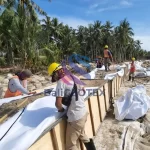
Engineers deploy geobags across multiple sectors. Coastal teams stack them to build breakwaters and revetments. Landfill operators place them around drainage zones for filtration. Road builders sometimes rely on geobag retaining walls where concrete would cost too much or access remains limited.
What are the specification of geobags? Includes fabric type, GSM weight, tensile and seam strength, AOS, permeability, and UV resistance. BaliGEOTEX offers high-quality geobag solutions designed to support erosion control, shoreline protection, and soil stabilization for various infrastructure and environmental projects. BaliGEOTEX geobags are a reliable choice for long-term protection and sustainable construction needs.
For more information about Geobag please contact: Whatsapp/Mobile Phone: +62 822 9933 3938 (Ms. Panni) or Email : info@baligeotex.com