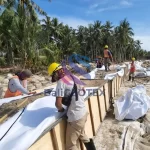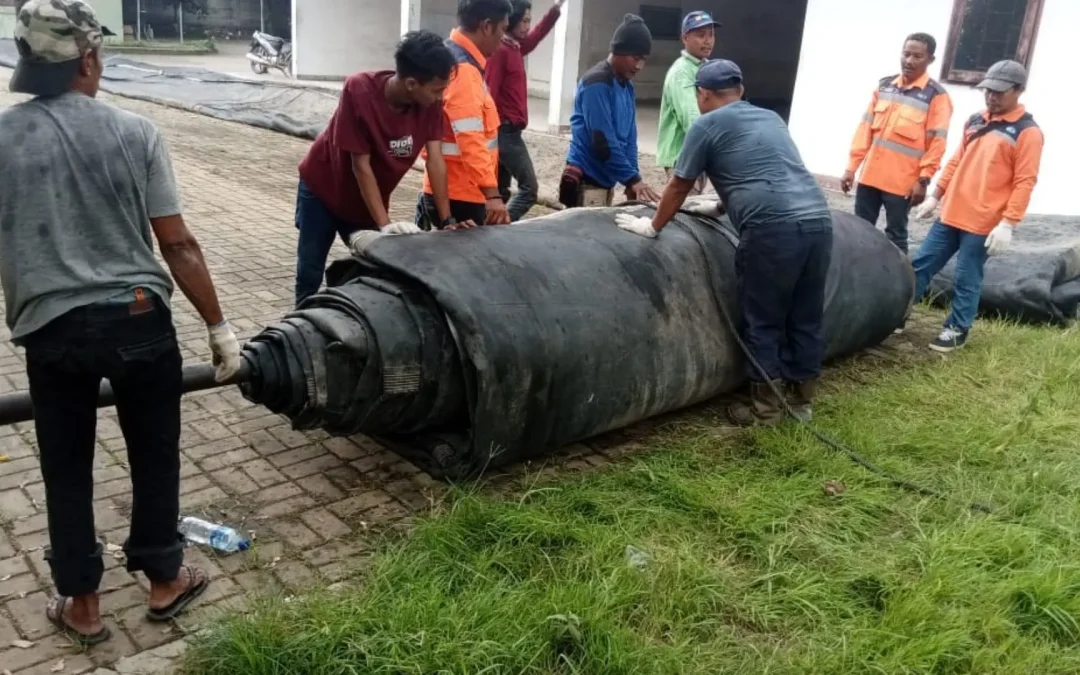
Geotube size and capacities vary a lot because they can be made according to project needs. They come in small, medium, and large sizes depending on where they’re placed and what they’re used for. Here, we’ll go into more detail about the sizes and capacities of geotextile tubes.
Getting to Know Geotube Size and Capacity
A geotube, or geotextile tube, is basically a big, long bag shaped like a tube made from porous geotextile material. These geotextile bags have lots of uses—they’re strong and durable, have good water permeability, resist UV rays and chemicals, and are easy to install.
Geotubes have a wide range of uses, such as protecting coastlines by breaking waves and preventing erosion. Other benefits include strengthening dams and flood control, drying sludge at city wastewater treatment plants, port or dock construction, mining waste management, road construction, and much more.
The size and capacity of geotextile tubes can actually vary a lot because they are custom-made. This means users can decide the size of the geotextile tube that best fits their project needs. Below, we’ll go over some example sizes and capacities in general.
Common Geotextile Tube Sizes
In general, this is the geotube size in terms of length, diameter, and circumference:
Length
The length of geotubes ranges from 10 to 100 meters or even longer depending on the project needs. For example, for coastal protection and breakwaters, they are usually 50–100 meters long. The goal is so that the geotube doesn’t easily shift because of the sea currents. For emergency levees, a length of 20–50 meters is necessary, and for industrial sludge dewatering, 30–60 meters is typical.


Diameter
Their diameter ranges from 1.0 meters to 10 meters. For purposes like drying, coastal protection, and coastal land reclamation, the diameter is about 3–5 meters. Meanwhile, for offshore breakwater structures or retaining seawalls, the diameter is bigger, starting from 5 meters up to more than 8 meters.
Circumference
The circumference of a geotube also varies a lot because it depends on its diameter and length. But in general, the perimeter ranges from 14.1 meters to 28.3 meters or even more, depending on your needs. Knowing the circumference is important during the geotube making process to determine the width of the geotextile sheet for making the tube.
Geotextile Tube Capacity
Geotube capacity really depends of the diameter, circumference, and the final height of the solids. The bigger the size of the geotextile tube, the larger its filling capacity. Conversely, the smaller the geotextile tube, the smaller its filling capacity. Usually, this capacity is measured in cubic meters.
For example, a geotextile tube with a circumference of 4.6 meters, a diameter of 1.5 meters, a length of 30 meters, and a final solid height of about 0.9 meters has a capacity of around 35–45 cubic meters. Then, if a geotextile tube has a circumference of 9.1 meters, a diameter of 3 meters, a length of 30 meters, and a final solid height of about 1.5 meters, its capacity is around 130–160 cubic meters.
Geotube capacity and size really vary. Users can choose according to their project needs. Picking the right size for a project or need is really important to ensure success, safety, as well as time and cost efficiency.
For more information about Geotube please contact: Whatsapp/Mobile Phone: +62 822 9933 3938 (Ms. Panni) or Email : info@baligeotex.com