How do geotextile bags compare to traditional sandbags for flood defense is important for us to understand. Flooding remains one of the most common natural hazards affecting communities around the world. When water levels rise rapidly, temporary barriers are often required to protect homes, infrastructure, and critical facilities.
For decades, traditional sandbags have been widely used as a simple and accessible solution to slow down or redirect floodwater. However, advances in construction materials have introduced alternatives such as geotextile bags.
Although both geotextile bags and traditional sandbags serve a similar purpose, they differ in several aspects. Such as material composition, durability, performance and long-term efficiency. Understanding how these two solutions compare can help project planners, emergency responders, and property owners choose the most suitable protection.
![geotextile bag merk BaliGEOTEX[2]](https://indonesiageotextilefabric.com/wp-content/uploads/2026/02/geobag-merk-BaliGEOTEX-12_22_11zon.webp "geotextile bag merk BaliGEOTEX[2]")
Understanding How do Geotextile Bags Compare to Traditional Sandbags for Flood Defense
Geotextile bags are containers made from geotextile fabric, a synthetic textile material commonly produced from polypropylene or polyester fibers. These fabrics are engineered to be strong, durable, and resistant to environmental factors. Such as moisture, UV exposure and mechanical stress.
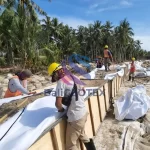
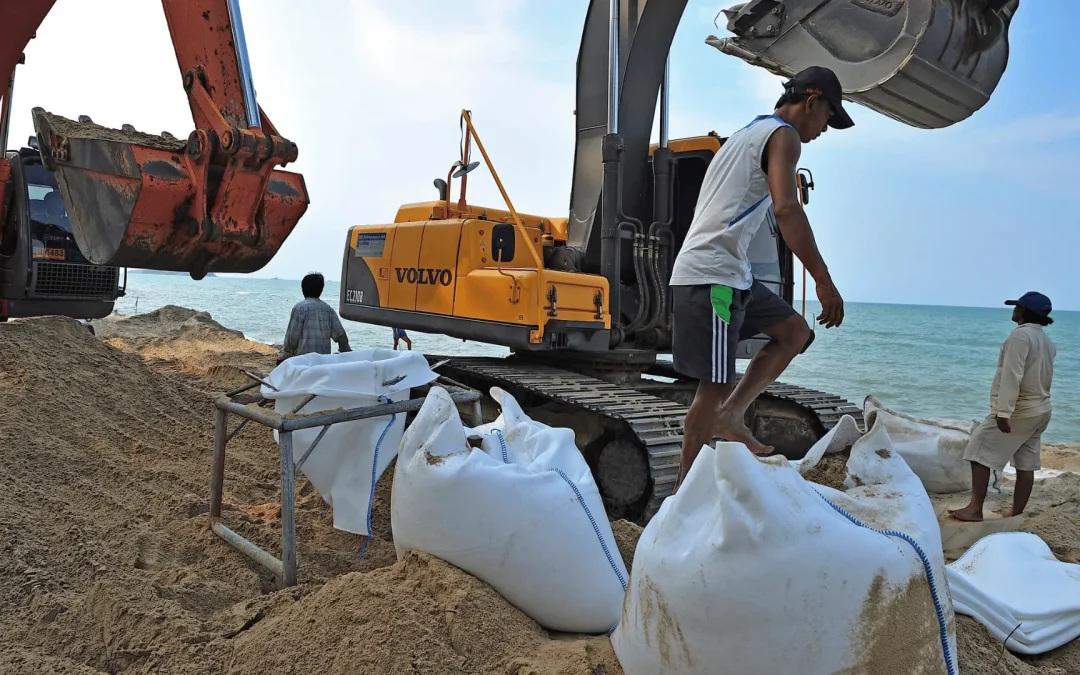
The bags are typically filled with sand, soil, or other granular materials and then stacked to create barriers against water flow. Because the fabric is permeable, water can pass through the material slowly while soil particles remain contained inside the bag. Geotextile bags are commonly used in civil engineering and environmental protection projects, including:
- Flood control structures
- Riverbank stabilization
- Coastal protection
- Erosion control systems
- Temporary or semi-permanent embankments
Meanwhile, traditional sandbags are simple bags filled with sand or soil and used as a temporary barrier to block or redirect water during floods. Historically, these bags were made from burlap (woven jute). Although modern versions are often produced using woven polypropylene.
Sandbags are widely used in emergencies because they are inexpensive, easy to transport, and quick to deploy. They are commonly stacked in layers to create a barrier that reduces water flow or prevents floodwater from entering buildings. Typical uses of traditional sandbags include:
- Emergency flood defense around homes
- Temporary protection of doors and windows
- Small-scale flood barrier
- Short-term water diversion
![geotextile bag merk BaliGEOTEX[6]](https://indonesiageotextilefabric.com/wp-content/uploads/2026/02/geobag-merk-BaliGEOTEX-8_4_11zon.webp "geotextile bag merk BaliGEOTEX[6]")
How do Geotextiles Compare to Traditional Sandbags for Flood Defense: Choosing the Right
Choosing between geotextile bags and traditional sandbags depends largely on the purpose and scale of the flood defense system. Traditional sandbags are generally the best option for emergencies where quick and simple protection is needed. They are easy to distribute, fill, and deploy, making them ideal for community-based flood response efforts.
Geotextile bags, however, are more suitable for projects that require stronger and longer-lasting flood control solutions. They are particularly useful in infrastructure protection, shoreline stabilization, and engineered flood barriers.
Flood defense strategies often rely on simple yet effective barrier systems to reduce the impact of rising water levels. Both geotextile bags and traditional sandbags can play an important role in protecting infrastructure and communities from flooding.
Traditional sandbags remain a practical choice for rapid emergency deployment due to their simplicity and availability. Meanwhile, geotextile bags offer greater durability, filtration capability, and structural strength. It’s making them a more suitable option for long-term flood protection projects.
Understanding how do geotextile bags compare to traditional sandbags for flood defense helps select the most effective method. Especially for managing flood risks in different situations. In some cases, both solutions can complement each other. Sandbags may be used for immediate response, while geotextile bags are installed later as part of a more durable flood protection system.
For more information about Geobag please contact: Whatsapp/Mobile Phone: +62 822 9933 3938 (Ms. Panni) or Email : info@baligeotex.com