Constructing paved infrastructure over soft, saturated, or low-CBR (California Bearing Ratio) subgrade is one of the most complex geotechnical challenges in civil engineering. When heavy logistics machinery rolls over a weak subgrade, the intense kinetic weight forces the expensive base-course stone down into the mud, while simultaneously pushing the mud up into the stone. This cross-contamination destroys the structural integrity of the pavement architecture, leading to severe surface rutting, asphalt cracking, and eventual structural collapse. To halt this downward aggregate migration and distribute massive vertical loads horizontally, geotechnical engineers specify a high strength woven geotextile as the foundational basal layer of the roadbed.
The Core Mechanics of Basal Reinforcement
Standard woven fabrics act primarily as a simple separator to keep dirt and gravel from mixing. High-modulus variants, however, are engineered to act as a structural, load-bearing membrane. They achieve ground stabilization through two distinct mechanical principles:
1. The Tension Membrane Effect
Imagine standing on a tightly stretched heavy canvas over a pit of mud; your weight causes the canvas to deflect slightly, but the tension in the fabric holds you up. When the wheel of a 40-ton articulated dump truck passes over the aggregate layer, the woven grid beneath absorbs that downward kinetic force. It stretches to a microscopic degree and translates that downward pressure into outward horizontal resistance across the wider subgrade.
2. Lateral Aggregate Interlocking
High-performance woven fabrics are manufactured with a textured, high-friction surface grid. When jagged crushed quarry stone is compacted directly on top of the fabric, the sharp edges of the stone bite into the woven apertures. This interlocking mechanism stops the base stones from sliding sideways under heavy wheel loads, completely eliminating lateral spreading.
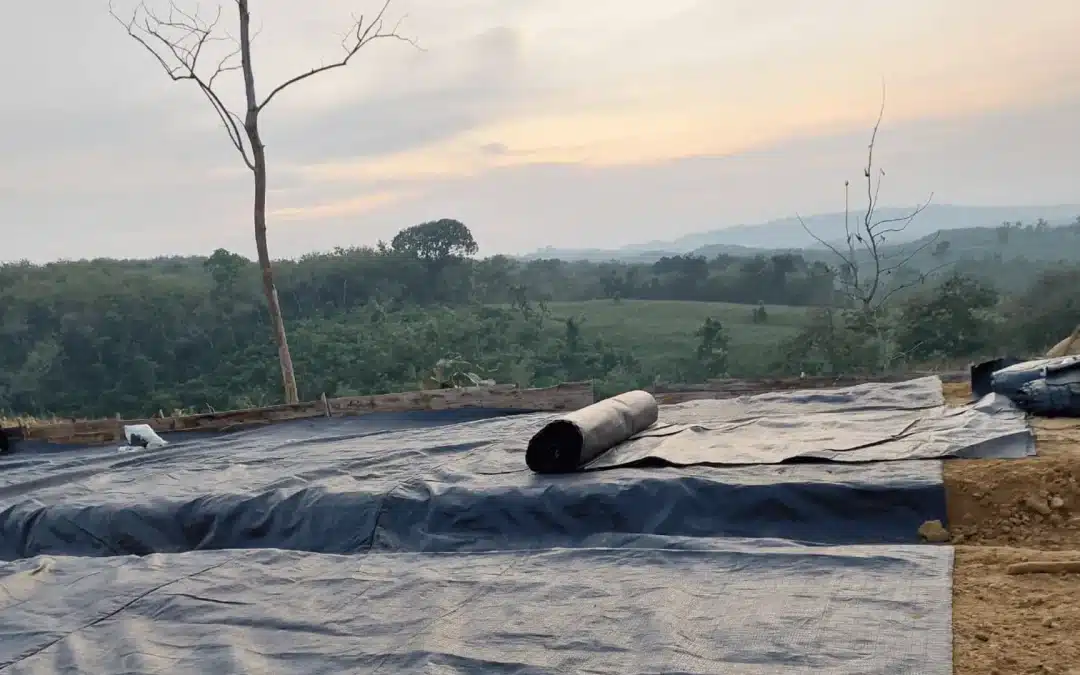
![Woven Geotextile merk BaliGEOTEX[1]](https://indonesiageotextilefabric.com/wp-content/uploads/2026/02/Woven-Geotextile-BaliGEOTEX-4_10_11zon.webp "Woven Geotextile merk BaliGEOTEX[1]")
Advanced Geotechnical Parameters to Verify
When reviewing a Technical Data Sheet (TDS) for heavy ground reinforcement, ultimate tensile numbers can be misleading. Engineers look specifically at three advanced laboratory metrics to ensure survival under extreme dynamic stress:
1. Tensile Modulus at Low Strain (2% and 5%)
This is the single most critical parameter in road design. A fabric that boasts a massive ultimate tensile strength, but must stretch 15% to achieve it, is practically useless—because by the time the fabric stretches 15%, the asphalt road above it has already sunk and shattered. High-modulus fabrics offer immediate resistance, absorbing the load at just 2% strain to keep the road surface perfectly flat.
2. Long-Term Creep Resistance
In geotechnical engineering, “creep” refers to the slow, permanent elongation of a polymer when subjected to a constant static load over decades. Standard slit-film plastics suffer heavily from creep. Premium reinforcement fabrics utilize high-tenacity Polyester (PET) or specialized Polypropylene (PP) multifilament yarns that refuse to yield over a 30-year design life, preventing embankments from slowly spreading outward over time.
3. Controlled Pore-Water Dissipation
A common misconception is that an ultra-dense woven fabric acts as a solid plastic tarp that traps water. In reality, structural woven fabrics maintain a highly calibrated permittivity. They allow built-up pore-water pressure from the saturated subgrade to escape upward through the fabric without carrying the fine silt particles with it, preventing the roadbed from liquefying beneath the stone.
Transforming Project Economics and CapEx
Beyond pure structural safety, integrating this specialized geosynthetic completely alters the capital expenditure (CapEx) of a civil site development.
Massive Aggregate Base Reduction
By utilizing a high-modulus basal reinforcement layer, native subgrades instantly achieve a higher effective bearing capacity. This allows site planners to safely reduce the required thickness of the imported crushed stone base course by 25% to 40%. On a multi-kilometer highway project, this translates to millions of dollars saved in quarry material purchasing, fuel hauling costs, and heavy machinery compacting hours.
![Woven Geotextile merk BaliGEOTEX[4]](https://indonesiageotextilefabric.com/wp-content/uploads/2026/02/Geotextile-woven-merk-BaliGEOTEX_7_11zon.webp "Woven Geotextile merk BaliGEOTEX[4]")
High-Consequence Civil Applications
Because of its extreme modulus rating and survivability class, this material is specified for severe civil environments where standard non-woven felts would fail immediately:
- Mining Haul Roads: Unpaved access roads built over peat, muck, or muskeg meant to withstand the repetitive rolling weight of 100-ton haul trucks.
- Basal Embankments: Towering highway approaches and bridge off-ramps constructed over soft, highly compressible coastal delta clay.
- Port and Intermodal Yards: Sub-base layers beneath concrete container stacking yards subjected to extreme static point-loads.
Subgrade failure is an unforgiving scenario; once a paved roadbed shears at the basal level, the only permanent remedy is complete excavation. Ground reinforcement is therefore not the place to compromise on unverified materials. By locking your sub-base down with a laboratory-certified high strength woven geotextile, you secure decades of maintenance-free infrastructure. Contact the engineering supply specialists at Urban Plastic to acquire strict, ASTM-verified geosynthetics tailored to the heavy load demands of your next site development.
For more information about Geotextile Woven please contact: Whatsapp/Mobile Phone: +62 822 9933 3938 (Ms. Panni) or Email : info@baligeotex.com