Every paved highway, suburban residential street, and industrial access route is fundamentally an engineering battle against the native earth beneath it. When heavy vehicles travel over an asphalt or concrete surface, the downward kinetic force is transferred through the upper pavement layers down to the native soil, known as the subgrade. If that native soil is soft or moisture-sensitive, the repetitive pounding causes the expensive imported aggregate base course to sink into the mud, leading to severe surface rutting, potholes, and structural shear. To prevent this slow deterioration and lock the pavement architecture in place over its lifespan, modern civil engineers rely on woven geotextile fabric for road construction applications as the foundational stabilizing layer.
The Twofold Mechanism in Pavement Design
Standard unpaved or poorly paved roads fail primarily due to cross-contamination. When clean, crushed quarry stone is placed directly onto a wet clay subgrade, traffic acts like a giant mortar and pestle, churning the dirt and stone together. Integrating a high-modulus woven fabric halts this process through two distinct mechanical principles:
Absolute Soil Separation
The primary duty of a woven geosynthetic in standard roadbuilding is to maintain a permanent physical boundary. Over a 20-year design lifecycle, the fabric prevents the fine, wet silt particles of the subgrade from pumping upward into the open voids of the crushed stone base. If those stone voids become filled with mud, the aggregate loses its stone-on-stone friction, turning a solid structural base into a liquefied, unstable slurry.
Horizontal Load Distribution
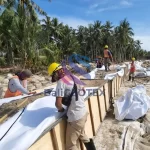
Beyond keeping the dirt and stone apart, the high tensile strength of the woven grid acts like a giant snowshoe. When a heavy axle passes over the pavement, the fabric absorbs the concentrated downward point-load and spreads the kinetic stress horizontally across a much wider surface area of the native soil. This drastically lowers the vertical pressure exerted on any single square centimeter of the subgrade.
![Woven Geotextile merk BaliGEOTEX[1]](https://indonesiageotextilefabric.com/wp-content/uploads/2026/02/Woven-Geotextile-BaliGEOTEX-4_10_11zon.webp "Woven Geotextile merk BaliGEOTEX[1]")
Mitigating the Top 3 Pavement Failures
Integrating a specialized woven polymer wrap directly beneath the base course addresses the most common and expensive modes of highway degradation:
Subgrade Pumping and Deep Rutting
In areas with high water tables or heavy seasonal rainfall, subgrade pumping is the leading cause of deep surface ruts. By holding the imported aggregate base firmly at its original design elevation, the woven wrap prevents the formation of “wheel-path depressions,” keeping the driving surface flat, smooth, and safe for high-speed travel.
Reflective Pavement Cracking
When a localized area of the subterranean subbase shifts or settles unevenly, the rigid asphalt layer above it bends and snaps. These subterranean fractures eventually “reflect” upward to the surface. A stabilized basal wrap acts as a structural shock absorber, neutralizing localized soil shifts before they can snap the upper wearing course.
Frost Heave Neutralization
In colder geographic regions, moisture trapped in the upper subgrade freezes and expands, pushing the road upward in jagged bumps. While woven fabrics cannot stop the ground from freezing, their calibrated permittivity allows excess rising rising groundwater to pass through slowly without carrying the frost-susceptible silt with it, mitigating the severity of the heave.
The CapEx Advantage in Road Bidding
For civil contractors bidding on state, provincial, or municipal highway tenders, utilizing a premium woven separator offers a major competitive financial edge in the Bill of Quantities (BoQ).
![Woven Geotextile merk BaliGEOTEX[4]](https://indonesiageotextilefabric.com/wp-content/uploads/2026/02/Geotextile-woven-merk-BaliGEOTEX_7_11zon.webp "Woven Geotextile merk BaliGEOTEX[4]")
Optimizing Base Course Aggregate Depth
Because the woven membrane instantly increases the effective Structural Number (SN) of the unpaved subgrade, international DoT and AASHTO design guidelines permit engineers to safely reduce the required thickness of the imported crushed stone layer by up to 30%. On a major multi-lane highway project, eliminating just 10 centimeters of aggregate depth saves thousands of tons of quarry material purchasing, drastically lowering the contractor’s net bid price while improving overall road durability.
Building a resilient, low-maintenance roadway requires viewing the ground not as a static surface, but as a dynamic, shifting engineering variable. A road is ultimately only as permanent as the boundary layer that separates its expensive imported stone from the raw earth below. By anchoring your project’s sub-base with verified, laboratory-tested woven geotextile fabric for road construction applications, you completely eliminate the subterranean mechanics that cause early asphalt failure.
For more information about Geotextile Woven please contact: Whatsapp/Mobile Phone: +62 822 9933 3938 (Ms. Panni) or Email : info@baligeotex.com