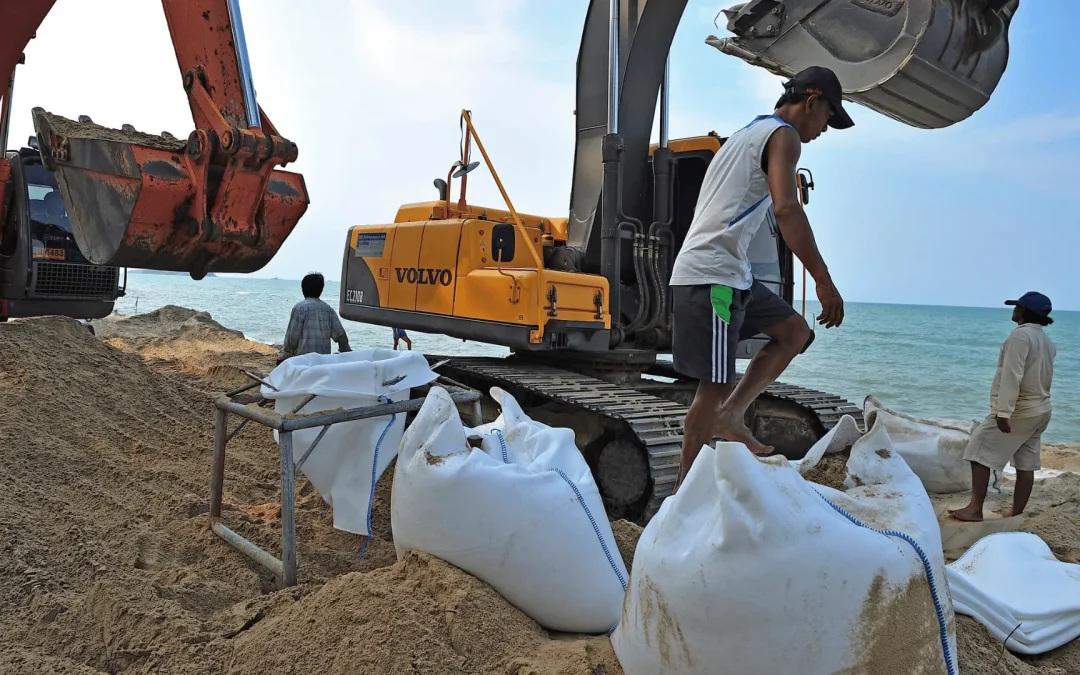
Mangrove rehabilitation in erosion-prone coastal areas often fails because young seedlings are highly vulnerable to wave action. As a result, temporary protective structures such as geobags are needed to create a more stable environment for mangrove growth. This method has been implemented in several regions across Indonesia, including Demak, Gresik, and Brebes.
Why Are Geobags Important for Indonesia’s Mangrove Forests?
Indonesia has over three million hectares of mangrove forests across its coastal regions. These ecosystems serve as natural coastal defenses, habitats for marine biodiversity, carbon sinks, and livelihood sources for coastal communities. However, degradation from erosion, strong waves, sea level rise, and human activities remains a major conservation challenge.
A key obstacle in mangrove restoration is the high mortality rate of seedlings in erosion-prone areas, where young plants are often uprooted before developing strong roots.
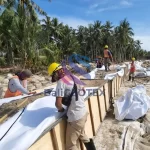
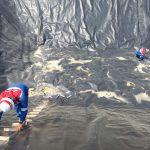
That’s why geobags have been implemented in various mangrove restoration projects across Indonesia as part of nature-based coastal protection strategies. In addition to reducing wave energy, geobags help accelerate sediment accumulation, which is essential for successful mangrove growth in coastal areas.
![geotextile bag merk BaliGEOTEX[1]](https://indonesiageotextilefabric.com/wp-content/uploads/2026/02/geobag-merk-BaliGEOTEX-13_23_11zon.webp "geotextile bag merk BaliGEOTEX[1]")
![geotextile bag / geobag merk BaliGEOTEX[2]](https://indonesiageotextilefabric.com/wp-content/uploads/2026/02/geobag-merk-BaliGEOTEX-2_16_11zon.webp "geotextile bag / geobag merk BaliGEOTEX[2]")
Examples of Geobag Applications for Mangrove Restoration in Indonesia
The use of geobags in Indonesia is generally focused on coastal areas that have experienced significant erosion. In many cases, mangrove planting is only carried out after geobag structures have successfully stabilized the surrounding environment. Several notable examples include:
1. Bedono and Sriwulan Coastal Villages, Demak, Central Java
Demak is one of the regions most severely affected by coastal erosion. In coastal villages such as Bedono and Sriwulan, geobags are installed together with bamboo structures to form low-crested breakwaters known as PEGAR (Pemecah Gelombang Ambang Rendah).
The geobags are placed several meters in front of mangrove rehabilitation areas and arranged parallel to the shoreline. When waves approach, the structures absorb and dissipate wave energy while trapping sediment carried by coastal currents. This creates calmer conditions behind the structures, making it easier for mangrove seedlings to survive.
As a result, seedlings are less likely to be uprooted, young root systems can develop more effectively, and sediment deposition becomes more stable. Once a sufficient layer of mud has accumulated and water conditions become calmer, mangrove species such as Avicennia marina are planted in the area. This approach has become one of the most successful examples of coastal erosion control measures in Indonesia, particularly in areas where natural mangrove protection has significantly declined.
2. Banyuurip Mangrove Center (BMC), Ujungpangkah, Gresik, East Java
Another example of geobag implementation can be found at Banyuurip Mangrove Center (BMC) in Ujungpangkah District, Gresik, East Java. In this area, geobags are installed along the shoreline to protect mangrove habitats from wave action and coastal erosion. The structures act as temporary barriers that reduce wave energy before it reaches the mangrove zone, creating calmer water conditions behind them.
These calmer conditions encourage natural sediment accumulation, allowing mud and sand to settle more easily. With a more stable substrate, mangrove seedlings have a higher chance of survival and growth. Beyond erosion control, geobags also provide surfaces where coastal organisms such as macrobenthos can attach and thrive.
The presence of these organisms contributes to ecosystem recovery and helps improve the overall health of the mangrove habitat. This project demonstrates how coastal erosion control measures can support both shoreline protection and ecological restoration simultaneously.
3. Keraya and Bogam Villages, West Kotawaringin, Central Kalimantan
The Central Kalimantan provincial government has distributed hundreds of geobags to Keraya and Bogam Villages as an emergency response to coastal erosion. The geobags were installed at critical locations experiencing severe shoreline degradation and serving as mangrove rehabilitation sites.
Similar to the Banyuurip project, the structures help reduce wave energy reaching newly planted mangroves. Consequently, mangrove seedlings have a much higher survival rate compared to sites without additional protection.
The primary goal is to provide initial protection, stabilize planting areas, retain sediment, and increase the effectiveness of rehabilitation efforts. This initiative highlights the importance of mangrove seedling protection systems in regions where ongoing erosion threatens both coastal land and ecosystem recovery.
4. Randusanga Geobag Seawall, Brebes, Central Java
In 2023, the Brebes Regency Government, together with local community groups, constructed a geobag breakwater known as the Randusanga Geobag Seawall. The structure, stretching approximately 1.5 kilometers, was built using sand-filled geobags to combat severe coastal erosion along the shoreline.
The seawall was specifically designed to address both coastal erosion and recurring tidal flooding, commonly known as rob flooding, which frequently affects the region. The geobag structure functions as an initial protective barrier for mangrove planting areas.
By reducing wave impact before it reaches the shore, the seawall helps slow shoreline retreat and creates a more stable environment for mangrove establishment. As sediment accumulates behind the structure, conditions become increasingly suitable for mangrove growth, enhancing the long-term effectiveness of local rehabilitation efforts.
For more information about Geotextile Bag please contact: Whatsapp/Mobile Phone: +62 8173 91338 (Ms. Agnes) or Email : info@baligeotex.com