What is woven geotextile used for? This question often arises. This is because many people still don’t understand what geotextile fabric actually is. There are actually many lightweight woven geotextiles that are easy to install and resistant to biological degradation.
These fabrics specifically offer strength and durability for construction and civil engineering purposes. With their resistance to harsh environmental conditions and their contribution to mitigating the risk of natural disasters, woven geotextiles are a fundamental and essential component for ensuring the reliability of construction and textile projects.
Learn More About What Woven Geotextile is Used for?
Woven geotextiles are a type of geosynthetic made through a process of weaving yarns, usually polypropylene or polyester, using industrial weaving machines. The result is a synthetic fabric sheet with a very strong and regular cross-woven structure.
This fabric is specifically designed to provide exceptional strength and durability. It can be used for various construction and civil engineering applications. This fabric is intentionally made by tightly weaving high-quality yarns to form a stable and dense structure.
To increase durability, the fabric is treated with UV stabilization. This allows the fabric to withstand prolonged exposure to sunlight and even harsh environmental conditions.
![Woven Geotextile merk BaliGEOTEX[1]](https://indonesiageotextilefabric.com/wp-content/uploads/2026/02/Woven-Geotextile-BaliGEOTEX-4_10_11zon.webp "Woven Geotextile merk BaliGEOTEX[1]")
Drainage Systems
In civil engineering, drainage systems aim to channel water away from structures to prevent the accumulation of pressure that could cause damage. Woven geotextiles are often used as supporting components to ensure drainage channels remain clean and functional for a long time. Woven geotextiles with a specific density are often used in drainage systems that require extra tensile strength.
Geotextiles allow water to flow through their weave. The material then retains fine soil particles so they don’t wash into the drainage pipe or aggregate layer. It acts as a filter to prevent clogging and acts as a stabilizer. This keeps the channel structure in place. The use of this material significantly reduces future drainage maintenance costs.
Erosion Control
One of them is erosion control. Erosion is a real threat to infrastructure stability and environmental sustainability. Without proper protection, rainwater flow or ocean waves can erode the soil layer and cause landslides or the collapse of structures above it. This is where woven geotextiles come into play as a robust technical solution.
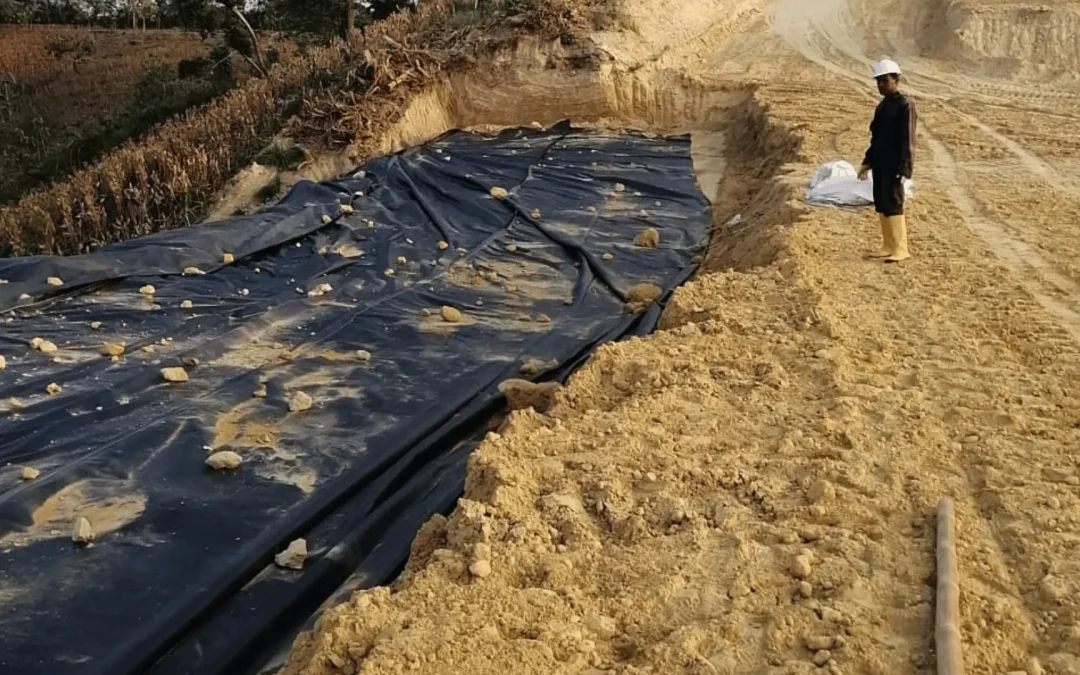
Installed between the original ground surface and an outer protective layer (such as crushed stone or gabions), this material acts as a filter, allowing water to drain away while retaining soil particles so they don’t wash away.
![Woven Geotextile merk BaliGEOTEX[4]](https://indonesiageotextilefabric.com/wp-content/uploads/2026/02/Geotextile-woven-merk-BaliGEOTEX_7_11zon.webp "Woven Geotextile merk BaliGEOTEX[4]")
Separation
Without separation, the fine subgrade often mixes with the crushed stone or gravel above it due to vehicle loads. If this happens, the road structure will quickly deteriorate. Woven geotextiles act as a barrier (separator) to prevent the two layers of material from mixing, thus maintaining the long-term function of each layer.
By preventing mixing, woven geotextiles ensure structural integrity and construction performance. This separation ability is especially valuable in projects involving multiple layers, such as highways, railways, and embankments. This material acts as a good barrier, preventing fine particles from entering while allowing for more efficient water flow. What is woven geotextile used for?
For more information about Geotextile Non Woven please contact: Whatsapp/Mobile Phone: +62 822 9933 3938 (Ms. Panni) or Email : info@baligeotex.com