Many people wonder, does water go through non-woven geotextile fabric? Especially considering its important role in the filtration and drainage system. To answer the question, we need to first understand what non-woven geotextiles are, how they differ from woven ones, and how water interacts through this material.
Understanding Does Water Go Through Non-Woven Geotextile Fabric?
Geotextiles are materials that are often used in various civil engineering and construction applications. Especially in projects that require soil stability or water management. Geotextiles are divided into two categories, namely woven and non-woven. Both have similar functions in terms of strengthening the structure as well as facilitating water management. It’s just that the way they work and the properties of the material are different.
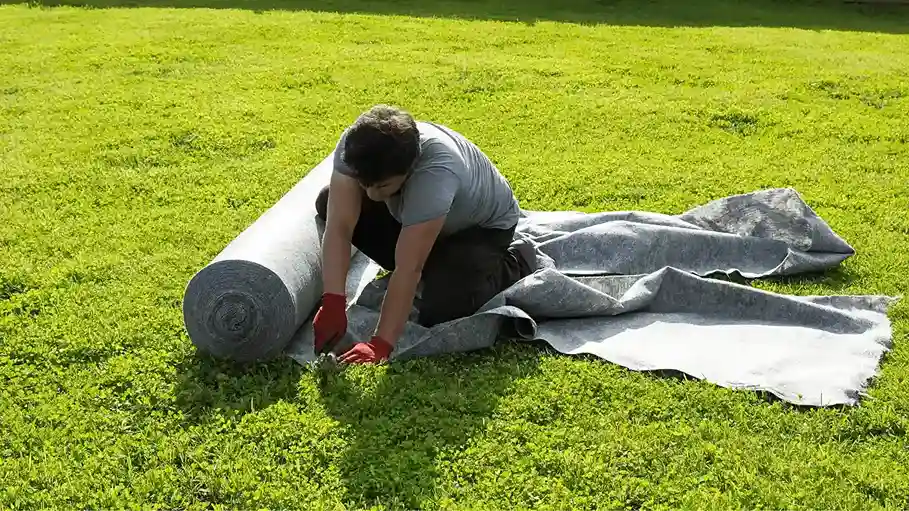
Woven geotextiles use woven or interwoven fibers systematically to form a strong and sturdy network. This type of geotextile is more durable and more suitable for applications that require high tensile strength and stability. Such as soil retention or structural reinforcement. In contrast, non-woven geotextiles are made by connecting randomly arranged fibers. The joining process is through chemical, thermal or mechanical. So that it produces a flexible and lightweight material. This makes it ideal in applications such as filtration, drainage and soil reinforcement. Because its structure allows fine particles or water to pass through the material more easily and optimally.

Effectiveness of Water Flow Penetrating Non-Woven Geotextiles
After understanding the difference between woven and non-woven geotextiles, we can return to the main question. Where do some people wonder does water go through non-woven geotextile fabric? The answer is yes, water can pass through non-woven geotextiles. This is one of the reasons why non-woven geotextiles are very popular in projects. Especially those related to water management. Its ability to allow water flow without sacrificing structural strength. Because the fibers in non-woven geotextiles are arranged randomly. There are many open spaces in it that allow water to flow through the material.
Water Absorption Capacity Varies
However, although water can penetrate non-woven geotextiles, it is important to note that this filtration ability is highly dependent on several factors. For example, the type and weight of the geotextile fabric itself. Some types of non-woven geotextiles are specifically designed to allow more water to flow. Others focus more on preventing soil erosion or strengthening structures. Even the size of each sheet can affect the ability to absorb water.
For example, measuring permittivity and permeability. Both will measure the rate of water flow through the fabric. So that can have a big impact depending on the landscape, drainage, subgrade, or pad. There is also the AOS technique with a higher percentage of open area. This ensures the size of the openings or weave to minimize clogging. So clogging by particles can be prevented early.
In addition, geotextiles are generally not designed to permanently block water flow. Their main function is only to help manage water flow. Not as a long-term water retention layer. Therefore, it is important to understand the needs of the project and choose the right geotextile to maximize the benefits of this material. Overall, the question does water go through non-woven geotextile fabric has been answered. This material does allow water to pass through its irregular and open fiber structure. Before using it, be sure to consider the specific needs of the construction or water management project being worked on.
For more information about Geotextile Non Woven please contact: Whatsapp/Mobile Phone: +62 8173 91338 (Ms. Imel) or Email : info@baligeotex.com